

Concealed Legacies: Bob Pettit

▬▬▬▬▬▬ ●
𝗨𝗻𝗱𝗲𝗿𝘀𝘁𝗮𝗻𝗱𝗶𝗻𝗴 𝗕𝗼𝗯 𝗣𝗲𝘁𝘁𝗶𝘁
⇊
When it comes to evaluating the many players to step on an NBA floor, I have developed a hatred for some of the general perception. Thanks in large part to the glitz and glamour of players like Pete Maravich, guys with less conventional “swag” like Bob Pettit have steadily received less and less of their deserved “flowers” over the years. Though that’s understandable considering he played a very long time ago, it’s always irked me to see Pettit so low on some of these basketball fan’s all-time rankings.
Though many people seem to recognize that Bob Pettit is an all-time great, he is one of the most under-appreciated talents to ever play. On top of that, some people won’t even mention his underrated status, instead they’ll mention Damian Lillard or Alex English, guys who have accomplished way less than him but are spoken of more because they have flashier play-styles.
Even if he rarely receives credit for his consistent production and insane numbers, it will never erase what has been able to accomplish. So today, we will analyze Pettit’s game in order to fully grasp what made him such a prestigious weapon.
═══ •
═══ •
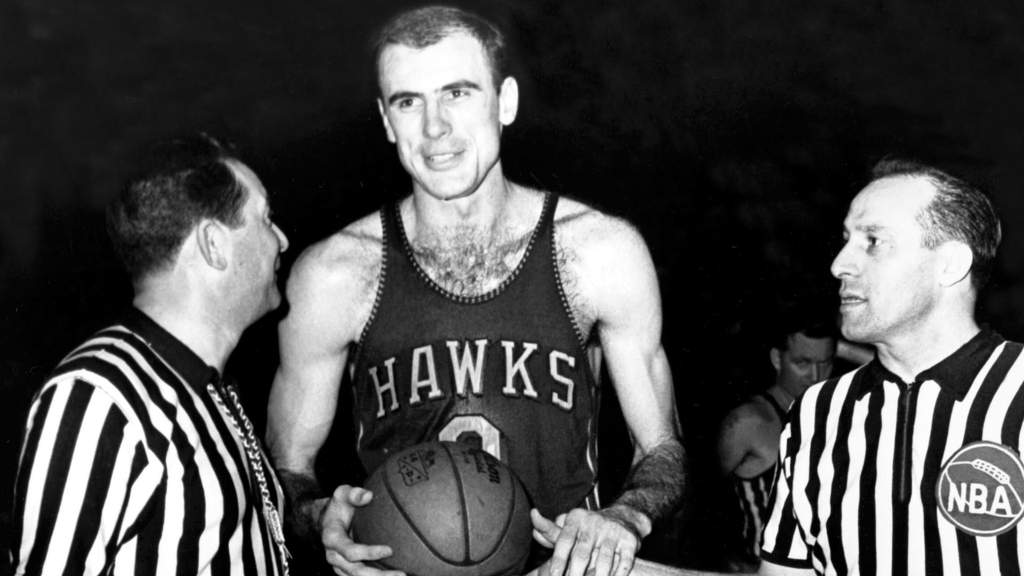
One of the more common misconceptions regarding Pettit, and more specifically his biggest rivals, is that he was never able to ‘compete’ with guys like Bill Russell and end up giving his Celtics’ a run for their money. At first glance, it’s very understandable how that may seem to be the case to fans who are less educated, because Russell is undisputedly higher all-time than Pettit. But it doesn’t necessarily correspond to the narrative that Pettit was never able to give the best of the best some challenge.
𝘾𝙖𝙧𝙚𝙚𝙧 𝙎𝙩𝙖𝙩𝙨
• 𝙼𝙿𝙶: 𝟹𝟾.𝟾 • 𝙿𝚃𝚂: 𝟸𝟼.𝟺 • 𝚁𝙴𝙱𝚂: 𝟷𝟼.𝟸 •
• 𝙰𝚂𝚃𝚂: 𝟹.𝟶 • 𝚃𝚂: 𝟻𝟷.𝟷% (+ 𝟺.𝟺 𝚛𝚃𝚂) •
Now, to those less knowledgeable fans, my next sentence may be ridiculous — Bob Pettit might be one of the 25 greatest players of all-time. In order to understand why one might think so highly of a player who played during the ‘plumber era’ let us breakdown Pettit’s offensive strengths and how greatly they impacted his team’s offenses.
Due to his size and position, Pettit’s role offensively was never to be a ball-dominant distributor. For that was a role his Hawks had reserved for players such as Slater Martin. His main role was also not to be the teams’ primary spot-up floor spacer (though he could certainly do it). Rather, Pettit’s job was to make life easier on the playmakers and he did just that with his scoring dominance on all angles.
With skills that included a nice touchdown pass, timely physicality on the offensive glass, and fantastic awareness, claiming that Pettit was an elite offensive threat even at his frame might just be a huge understatement. Paired with his nice mid-range shot, which he could consistently hit on nearly any defender at almost any angle, Pettit was also adept at driving and cutting to the rim for easy baskets, making him a true scoring machine without even needing to be the primary ball-handler.
This kind of ability made it very difficult for defenses to contain him without being forced to commit any extra attention. As he made himself more a portable option, it became easy for him to play with any kind of player (and for the front office to build around him). This dominating versatility also allowed for the St. Louis Hawks to consistently have a top 3 offense in the league. This hasn’t been consistently matched by any other Hawks player since.
•••
Here’s a look at what made the offense so good. As seen in the video below… he took advantage of defensive miscommunications and consistently knocked down perimeter shots.
═══ •
═══ •
If the defense committed too harshly, before they even had a chance to react, Pettit has just scored 2 points under the rim utilizing his feline quickness to slice and dice through the defense.
═══ •
═══ •
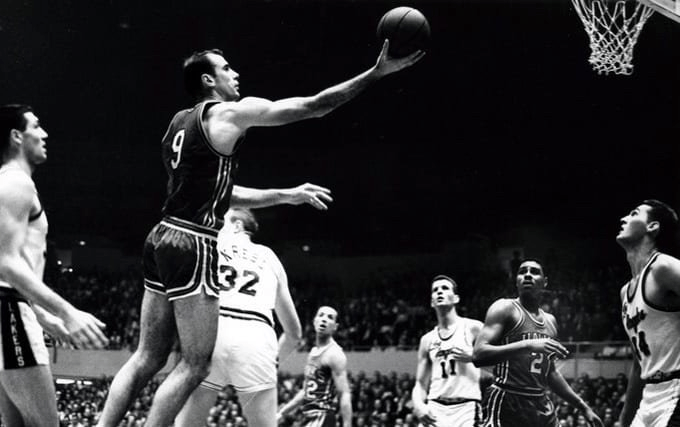
The amount of offensive gravity Pettit possessed on the basketball court was insane and could arguably be seen as just as valuable as any level of individual shot-creating or passing ability the league has ever had the luxury of witnessing. At the time, Bob Pettit was probably the best scorer in league history; that was of course until Wilt Chamberlain entered the league.
However, you must not be fooled by his offensive impact. Let it be understood that, while Pettit was elite at creating his own shot with or without the ball, ‘The Big Blue’ was no slouch when it came to getting physical on the glass. While his blocks and steals were never recorded, and film is limited when it comes to defense, one thing you can say for sure is that Bob had a good instinct to jump for a rebound when a shot went up.
When looking at rebounding percentage, it’s likely that he was roughly 17 percent in total rebounding rate during his peak. This is highly comparable to more recent bigs such as Anthony Davis or Pau Gasol. In the first five seasons that rebounding percentage was officially recorded — Pettit’s numbers ranked about 10th in a given season, or around the 80th percentile amongst all of the NBA’s bigs.
═══ •
═══ •
Speaking of the elite attributes Bob Pettit displayed, what wasn’t more impressive for its time than his fantastic longevity?
Back in the 1950s, sports, let alone basketball, didn’t have nearly as much technological advancements as we do today. Players would sprain their ankle, and it could’ve been career-ending. Players of the past just simply weren’t, and will never be, more fortunate than the players of today, and the future. Which is why 11 years of all-star caliber production by Bob Pettit was so inhuman.
Over that 11-season stretch of greatness, the Hawks maintained an rORTG above +0.4 on average. (This was really impressive for its time because there were less teams and it ensured more competition). This span also includes a peak of +2.5 in 1958-59. In all of those seasons, Pettit never averaged under 21 points per game (per 75 adj.), 13 rebounds per game (per 75 adj.), and was almost always shooting at at least league average efficiency.
As much as we talk about the absurd longevity of Kareem Abdul-Jabbar, Kobe Bryant, and LeBron James, Pettit continues to remain the only player to retire on his own terms. He was an all-star for all of his seasons, and it was his choice to retire, not his body.
He retired having accumulated 20,880 points, the most ever scored in the NBA at that time, and his 12,849 rebounds ranked him second. His rebounding totals were no less impressive: his career average was 3rd best in league history behind Wilt Chamberlain and Bill Russell, who are widely considered to be the two greatest rebounders ever.
═══ •
═══ •
The slightly less impressive, but far more important piece to Pettit’s excellence, is that he did it when the lights were brightest. As incredible as he was in the regular season, Pettit was one of the best playoff performers in NBA history.
The thing with Pettit’s offensive style and attack was that it was hard to strategize against. You couldn’t control his crazy leap that helped him grab all those rebounds, and you couldn’t control his insane scoring. He wasn’t a system player; the system and the opponent’s defensive game-plan revolved around him. Despite his low assist numbers, he wasn’t a ball-stopper; rather, just the opposite as he was quick with his decisions and even if he was, it didn’t matter because he was too effective. You couldn’t take him out of the game; even when he wasn’t shooting very well, he was so impactful because you still have to watch out for his rebounds and his ability to execute fast-breaks with touchdown passes. Even against the roughest of defenses, he was nearly unstoppable.
Take a look at every major statistic you can find, Pettit’s numbers improved everywhere for the majority of his lengthy postseason career.
𝗥𝗲𝗴. 𝗦𝗲𝗮𝘀𝗼𝗻 -> 𝗣𝗼𝘀𝘁𝘀𝗲𝗮𝘀𝗼𝗻
PTS: 26.9 -> 27.0
REB: 16.5 -> 15.6
AST: 2.8 -> 2.9
TS%: 50.4% -> 51.2%
PF: 3.2 -> 3.1
FT%: 76.1% -> 77.4%
FTA: 10.3 -> 10.4
Whether it be the regular season or the postseason, Bob Pettit’s play was always among the best in the league. The only category that gets worse in the playoffs is rebounding, he scores more, is more efficient, is even more aggressive at getting to the line, and he fouls less.
There have been plenty of criticisms and narratives (fair or not) that have surrounded Bob Pettit’s successful career—the ‘plumber’ and ‘underwhelming perimeter defender’ statements are the most common. However, what cannot and should not be overlooked, is that Bob Pettit was so much more than an ‘unskilled white dude’.
What Pettit brought to the table on a night-to-night pattern was one of the most underrated and deepest skillsets of any player we’ve had the pleasure of witnessing. His shooting touch, rebounding, creation, and his relentless aggression despite his huge frame allowed for some of today’s most dynamic forwards, such as Khris Middleton, Jayson Tatum, and Kevin Durant to play in a similar fashion. He was certainly a pioneer for shot-creating wings and bigs and was far ahead of his time.
Why Is He Overlooked?
═══ •
═══ •
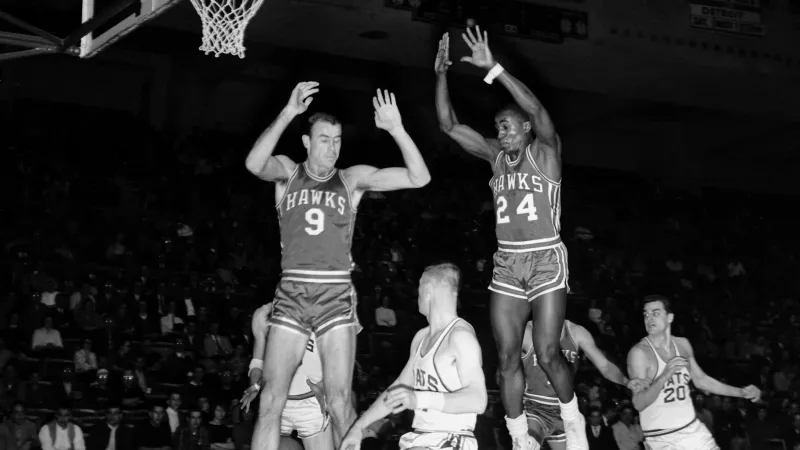
As you reflect on this piece; you may be wondering why Pettit is so underrepresented in league discourse. After all, when someone is truly great at something, they tend to be legends, their stories are retold and they remain household names for years. So why hasn’t Pettit gotten this treatment? Well, I have a few theories.
Theory 1: The Pioneer Effect
═══ •
═══ •
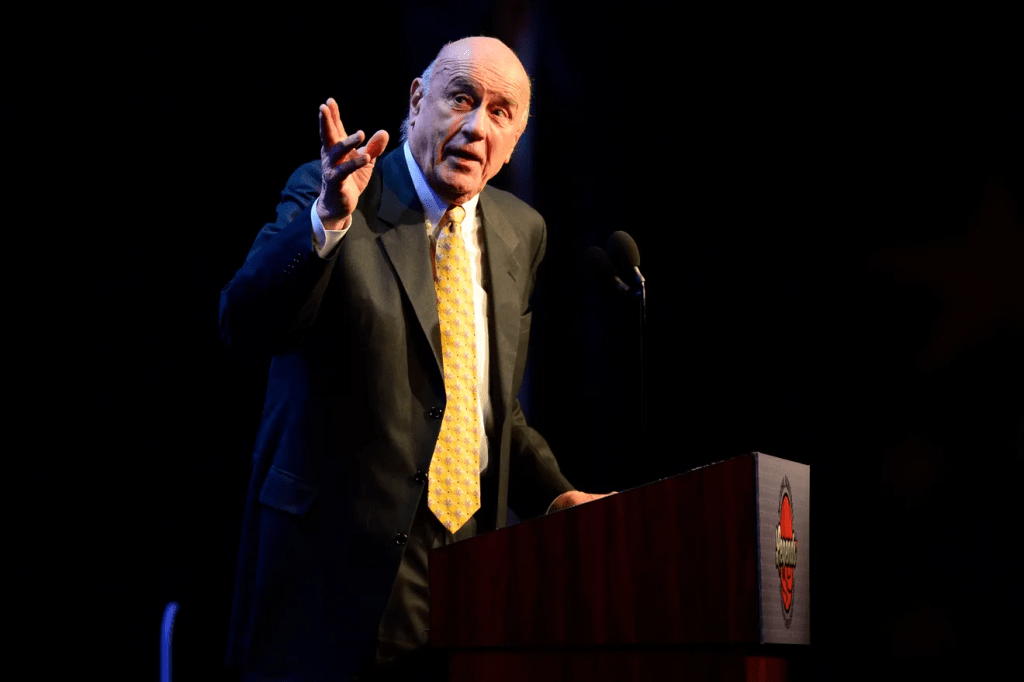
As you can tell, Pettit is an OLD man. This comes with a lot of benefits and detractors in regards to his image. On one hand, because of his age, we can credit him for his innovation changing how we view the roles of future Power Forwards. On the other hand, this means that we barely have any accessible footage of his play because the NBA was simply a young, underrepresented league that wasn’t prioritized by the few channels on American television in the 50s such as ABC. That fact was especially true for a small market like St. Louis, and this lack of care for the league is part of the reason we will never see Wilt Chamberlain score 100 points.
The sad truth is that I can sit here for hours and fawn over Pettit’s 50-piece in Game 6 of the 1958 Finals to completely dismantle the Celtics led by a classic Cousy stinker, but there’s barely any footage of that game. You can watch two minutes of it on YouTube, but the full package is lost media. Below is the extent to which you can immerse yourself in Pettit’s magnum-opus.
═══ •
═══ •
Admittedly, this footage is dope. Any self-respecting fan of basketball should want to preserve and commemorate this historical inkling of the game. But let’s be honest, casuals drive the NBA, they’re taking up the biggest portion of the league’s income and like it or not; casuals don’t like old, barely accessible players who were filmed on potatoes, they like the new, shiny players such as Giannis Antetokounmpo who will put his nuts on Tim Hardaway Jr’s face in 4K ultra HD. Pettit doesn’t check those boxes. However, neither do Russell, West or Robertson, but casuals and die-hards alike all love them. Those guys’ images have transcended shit cameras and the hammer that is the era-tax so I renounce the idea that Pettit can’t be given the same love. Unless, there was something deeper, perhaps more sinister at play.
Theory 2: Racism
═══ •
═══ •
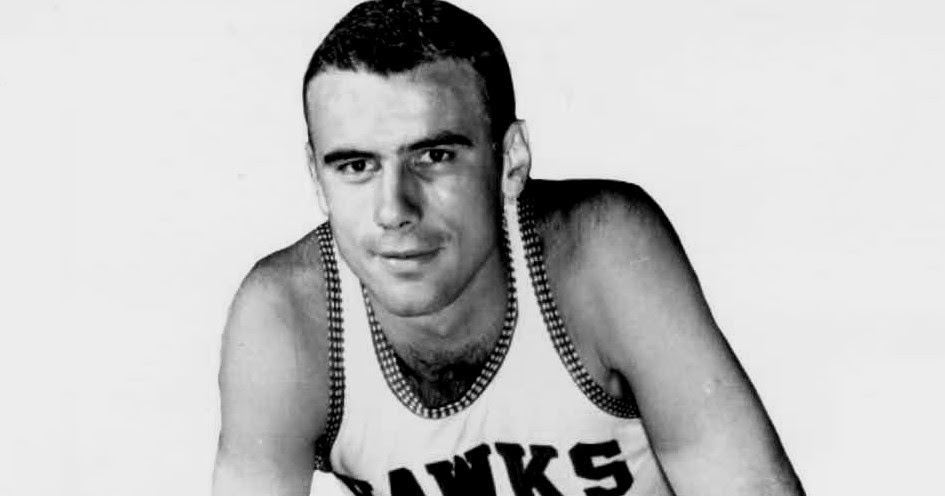
Now, I am in no way saying that Pettit’s whiteness is the reason for his lack of fame, in fact, I’m saying that the St. Louis Hawks’ well-documented history of downright evil, and by proxy, likely Pettit as well is the reason why we could care less to give a bigot like him credit, even if he may be reformed after all these years.
Did you know that Bob Pettit’s birth certificate reads “Robert Lee Pettit Jr.”? The guy who led the Confederacy in the American Civil War and deeply held belief in white superiority? Yeah, that dude Bob Pettit grew up in 1930s Louisiana, with a racist name and knowingly, willingly played for the most racist team of all-time, I don’t think his prejudice was supposed to be a tightly-knit secret.
You might be thinking that I’m being harsh and that this is all speculation but no, there are incidents directly relating to Pettit’s Hawks that were clearly racist. First, is the clear unwillingness to play with black people, no matter how talented they were. In 1962, Hawks guard Cleo “Machine Gun” Hill had the potential to become a rising star until he was blackballed from the league; and while the evidence is disputed, many believe that Pettit, along with his teammates Cliff Hagan, and Clyde Lovellette ran him out of town because of a variety of reasons. Hill claims it was over playing time, Coach Paul Seymour (who got fired for defending Hill) claimed that was a lame cover-up for racism, and in his autobiography, Pettit declared it was about playing time and a lack of synergy between the rookie Hill and the veterans. All I’m saying is that where there is smoke, there is usually fire and I wouldn’t be astonished if the truth is a combination of the 3 viewpoints. Hill only took 5 shots a game and only played 18 minutes a game, a far cry from another young star previously from the Hawks, sophomore Cliff Hagan who played 31 minutes a game and took 16 shot attempts in 1958. I wouldn’t be able to tell you why Pettit didn’t have the same animosity for Hagan as opposed to Hill, but it is documented that Hill was highly overconfident and sometimes didn’t “respect” his veterans. Sounds like bullshit to me, all professionals are cocky and that reasoning seems a little close to home with African Americans at the time needing to bow down to the white people in their lives. Not to mention, St. Louis infamously rejecting Bill Russell also doesn’t help anyone in the franchise’s image.
Now, Pettit potentially being a raging lunatic is mostly undocumented and just *how* far deep he was on the spectrum is left to interpretation but even then, bad people are beloved in the NBA all the time. Karl Malone, a KNOWN pedophile who impregnated a 12 year old got to enjoy a long-lasting career in the NBA free of the same underrepresentation of Pettit, some may even argue he is given far too much limelight for such an awful human being. So, what exactly is the deal for Pettit? Why can’t casuals seem to name him as one of the “crème de la crème”?
Theory 3: Lack of Longevity
═══ •
═══ •
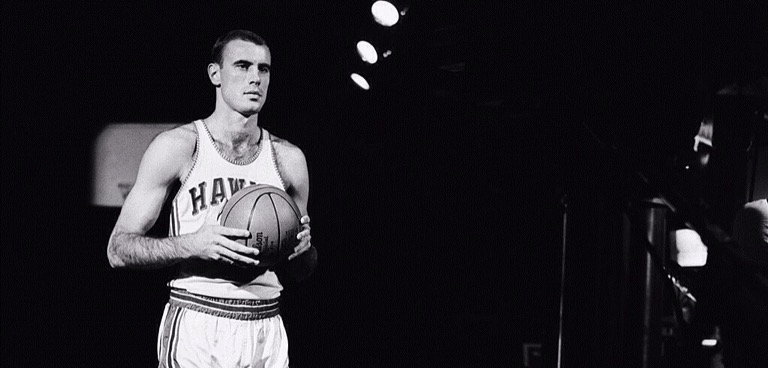
For the third and final theory, we will uncover an unfortunate truth about the first ballot hall-of-famers career. That truth is, Pettit and his Hawks were never as relevant in the 60s as they were in the 50s; and it’s because of this that some may think of his peak as closer to the Johnston/Mikan era rather than the Russell/Chamberlain era.
The association of those Hawks being closer to a 50s era team than 60s has made it more confusing for newer fans to really dig down and index Pettit’s contributions to an all-time scale because we know that the first relatively well-documented era of the NBA indeed WAS the 60s. This is when we began to get a lot more game footage of legends and when more traditional stats started being counted. And while Pettit and the Hawks weren’t necessarily WASHED, the era was over when Pettit retired in 1965 and that was only after the team began showing signs of regression. Those signs being the dysfunctional head-case that was the 1962 Hawks, followed by getting eliminated at the hands of West, Baylor and the Los Angeles Lakers of 1963, Wilt’s Philadelphia Warriors in 1964 and being upset by Bellamy’s mediocre 1965 Baltimore Bullets. A series in which Bob mightily struggled, only averaging 11 and a half points in his swan song of a series. Mind you, all of these playoff exits came before even being able to clinch an NBA Finals berth, which had largely served as a second home for St. Louis from 1957-1961.
This lack of sustained success for the Hawks led to their rivalry with Russell’s Celtics being overshadowed by the new, up and coming teams like Jerry’s Lakers and the Stilt’s Warriors and Sixers.
Although they lost every single matchup against Boston but one, that rivalry being remembered would have served as Pettit’s lame claim to fame. Fans may have looked back on the memorable matchups of years past where Pettit and Russell had wars on the glass. This would’ve likely contributed to Pettit’s name being in the discourses he belongs in more often than he is currently.
Obviously, that’s not what happened. After the 1965 playoffs, Pettit decided to hang it up due to sustaining an unfortunate knee injury that greatly impacted his play in his last season. While still being productive and all-star caliber, he missed All-NBA first team for the only time in his 11-year career; this time, he was ONLY a modest second team member. Washed, am I right?
Jokes aside, Pettit could easily see that his career was on the decline and NBA players, even superstars like Bob, didn’t make life-changing money yet. This led him to take on a career as a banker and though the league’s reputation continued to skyrocket in the late 60s and early 70s, Pettit wouldn’t be part of it. Instead, he watched from his office as his friends, colleagues and rivals continued to push the game forward.
Pettit left an amazing legacy, one that is likely left behind for a mix of all the reasons I listed above, but that doesn’t mean you shouldn’t allow him to continue to be forgotten and disrespected on all-time lists.
Essence: Separate The Artist From The Art
═══ •
═══ •
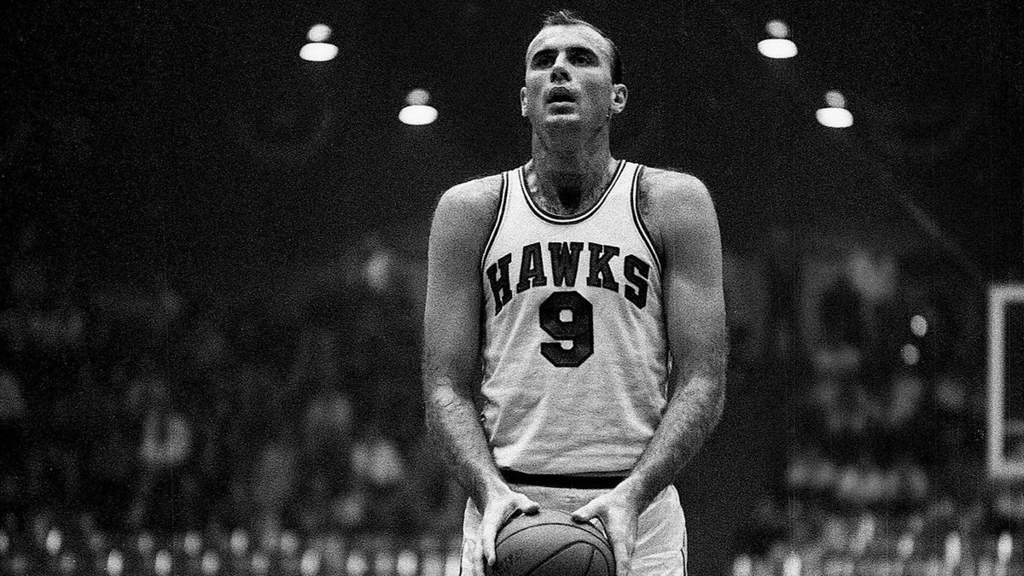
Whatever the reason may be, Pettit’s legacy seems to be concealed by those who refuse to learn more about older periods of basketball. And because of that; I challenge you to start talking about him more because he’s still here and his revolutionary play deserves respect before he’s gone, and after.
The NBA was and still is a league of superstardom and dynasties. From Russell, to Kareem, from Jordan to LeBron. We remember it’s history through each era’s champions and GOAT’s. At the time, nobody was as good for as long as Bob Pettit. His success was completely unprecedented in the universe of 40s and 50s basketball. Aside from two seasons, the Hawks qualified for the playoffs every single season under Bob Pettit. He wasn’t just the savior of a franchise bound to go bankrupt, he WAS the Hawks and continues to be their unsung GOAT.
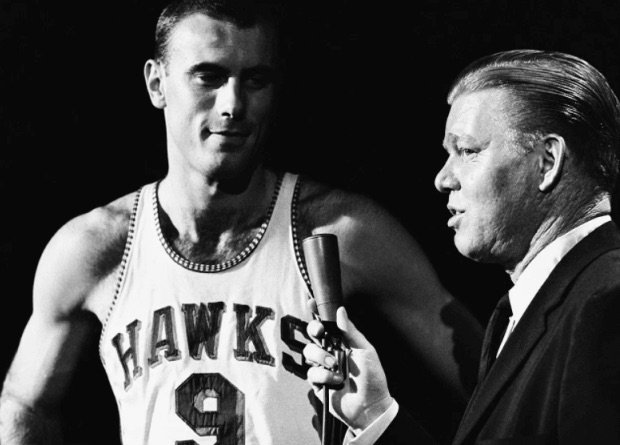
He was the cornerstone, the engine, the then-all-time leading scorer of basketball, being the first player to accumulate 20,000 career points. And if that wasn’t enough, he was the x-factor and leader of Bill Russell’s first challenger, rivaling his Celtics in the finals four out of five times, refusing to back down from adversity and taking on the daunting dynasty. Even going on a magnificent playoff run to finally dethrone the Boston Celtics in 1958. So I must propose a final question, if you and 29 friends were running an NBA franchise, and you could pick from 30 players to help lift your team into brand-new heights, why wouldn’t someone go with Bob Pettit?
Sure, his skills on both sides and particularly his astute work on the glass are what made him impact winning in a vacuum, but his attitude, work ethic, consistency, and ability to bounce back are what transcended him to the next level. It’s what makes him the revolutionary stud we all know and hopefully now respect, as Bob Pettit. A top 30 player, of all-time.
═══ •
═══ •
𝙏𝙝𝙚 𝙄𝙧𝙤𝙣 𝙂𝙞𝙖𝙣𝙩

 Title Runners