

Underrated Hoopers: Rasheed Wallace
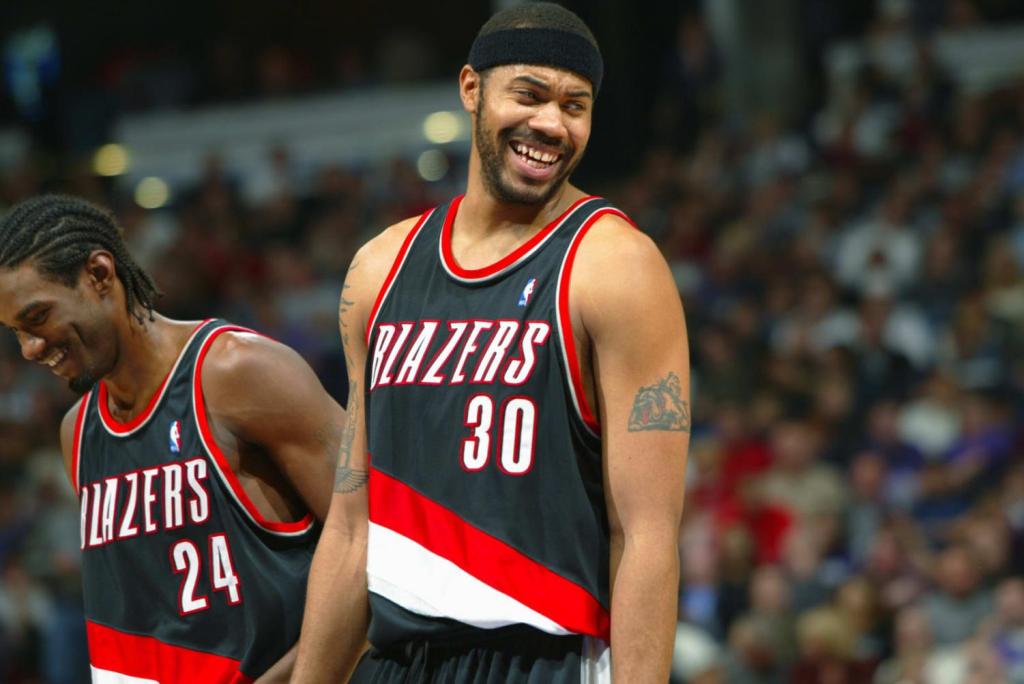
Rasheed Wallace is well known for a couple of things. On one side of things, he was a pivotal part of the 2004 Pistons team that shocked Kobe and Shaq and won the finals. Even more famously, he has the most ejections in NBA history, leading second place with six ejections. But Wallace wasn’t just a hot head; he was a beast of a player, a four time All Star, and a champion. Lets dive into Sheed’s journey as a player, playstyle, and his overall career outside of his run ins with the refs.
Career Path

Wallace went to UNC for his two years of college, the second of which he led the entire NCAA in field goal percentage, two point percentage, and effective field goal percentage. This was enough to catch the eye of NBA scouts, and the Washington Bullets took him with the fourth overall pick in the 1995 NBA draft. He played okay in Washington, putting up 10 and 5 in his rookie year, but his days were numbered. The Bullets traded him to Portland for Rod Strickland and Harvey Grant, hoping to fill their weaknesses at point guard.
Now Wallace had the chance to shine. His first year as a Blazer, his numbers jumped up to 15 and 7, and he recorded a block per game, a level he never dipped below until 2010. The Blazers had some very solid teams during Wallace’s tenure, making the Conference Finals twice in his eight years and never once missing the playoffs. He was a two time All Star in Portland, and the team was prominent in a very competitive West, one that featured great teams like the Spurs and Lakers.
Unfortunately, the Blazers made the news off the court as well. Dubbed the “Jail Blazers” the group was often getting in trouble for drug possession, violence, or fights in practice. Wallace himself wasn’t the worst of the crew, but he did have a run in with the law over the possession of marijuana. These antics didn’t help the teams PR, nor did it help their chemistry, and the team could never quite reach their ceiling.
Looking to get away from this reputation and rebrand, the Blazers decided to move on from Wallace. They shipped him away to Atlanta in exchange for Shareef Abdur-Rahim, Theo Ratliff, and Dan Dickau. Sheed played just one game in Atlanta, and even though it was a very solid game, they then shipped him in a three team deal to Detroit. The three team trade involved Boston, who received Chucky Atkins, Lindsey Hunter, and a first rounder. The Hawks received Bobby Sura, Zelko Rebraca, and Chris Mills, while the Pistons ended up with Wallace and Mike James.
The Pistons won that trade, and they would prove it in that very season. The Pistons went all the way to the Finals that year and shocked the Kobe and Shaq led Lakers, winning the Finals in five games. Sheed put in a very solid 13 and 8 during that series, along with a block and a half. The Pistons were back in the Finals the very next year, although they lost to the San Antonio Spurs in seven games.
Rasheed returned to the All Star game twice during his tenure in Detroit, in 2006 and 2008, and he consistently received at least some DPOY votes. In 2010, he left Detroit to go to Boston, where he made the Finals one last time, although they lost to Kobe and the Lakers that year. After 2010, he retired for two years, although he came back in 2013 at the age of 38 to play 21 games for the Knicks.
Peak

So with six total teams, where did Rasheed really play his best basketball? As always, we’ll split his peak into two different categories: winning peak and individual peak. Winning peak is not directly associated with how much the team won, but how much Sheed helped impact winning, while individual peak is simply where he as an single player played his best basketball.
The winning peak is significantly easier to find for Wallace than the individual peak. Although the Trail Blazers had some solid seasons during Wallace’s tenure, they were never anywhere near the Pistons of the mid 2000s. Wallace and the Pistons made the Conference Finals four years in a row, from 2004 to 2007, including Finals appearances in both ’04 and ’05, topping it off with a championship in ’04. Wallace was a huge part of those teams, helping them create a brand as one of the best and toughest defensive teams in the NBA, and one of the most competitive.
The individual peak, however, is tougher to pinpoint. Wallace’s best scoring years came in Portland, as he was a more important part of the offense, especially during the second half of his time there. Statistically, he was at a higher level in Portland overall, but Detroit Wallace has a strong case as well. Wallace was more of a veteran in Detroit, and his playstyle changed a bit, and he was a two time All Star there, the same as in Portland. I am giving the nod to Portland Wallace at the end of the day, however, as he still provided his defensive impact while giving more on the offensive end. Specifically, the years 2000-03 could be pinpointed as his best years, as he became a main face of Portland’s identity and offense.
Playstyle
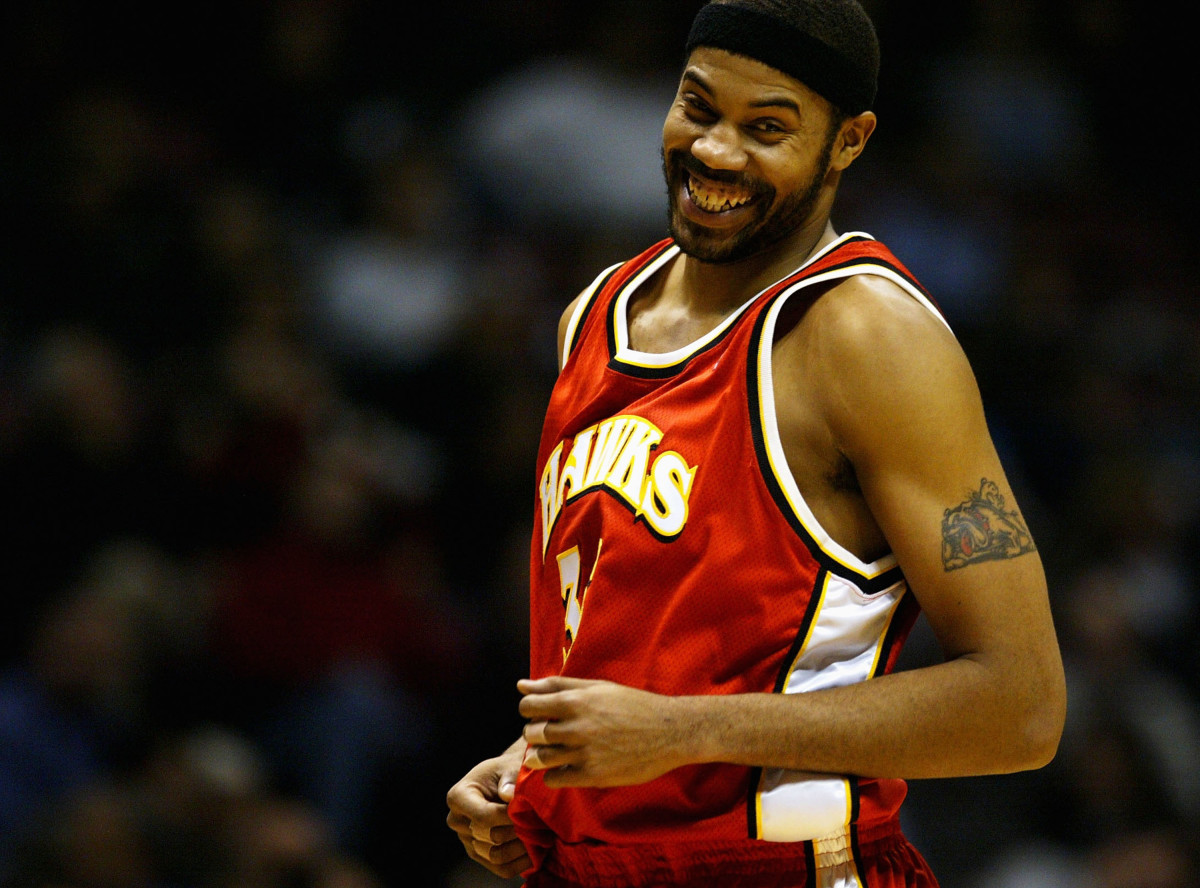
Sheed’s game was ahead of his time. Nowadays, big men across the league have a solid three point shot, something that they can use to space the floor in today’s three point centric league. But before that time, there was Rasheed Wallace. His three point fundamentals were shockingly good for a big from the 90s-00s, with a high release point and relatively quick motion. His shooting also improved drastically over time, as he attempted under one three per game during much of his time in Portland, but that skyrocketed up to over three per game for much of his later career.
But shooting was far from the only aspect of Wallace’s game. At 6’11”, 225, he could power his way to the rim, and finish hard, even through contact. He was also exceptionally solid in the post, with a strong frame and a silky smooth post fadeaway, allowing him to score very well when he got the ball in close to the rim.
On the other end of the court, Wallace was a very solid defensive player, his frame allowing him to be a good shot blocker and help defender, and his abilities and relative quickness allowing him to be rather versatile. This allowed him to be a big part of some solid defensive teams in both Portland and Detroit, although his impact was overshadowed by some star defenders like Ben Wallace and Scottie Pippen.
But of course, we can’t overlook one of the most famous parts of Wallace’s game: he was a hothead. The most ejections of all time, and a never-ending feud with the refs, Wallace was constantly getting into it with the authorities of the court. He also has the most technical fouls in a singular season, with a whopping 41 technicals in 2001, which is an average of one every other game.
Overall, Sheed is simply put one of the most versatile big men ever to play the game, with an extremely well rounded set of skills on both ends of the floor, a skill set that is well before his time. My current day comparison for Rasheed Wallace is Jaren Jackson Jr. Neither of the two are incredible rebounders, but both are really solid on both the offensive and defensive ends. Both can step behind the arc, and although Jackson Jr is a better shot blocker, and lacks the hotheaded nature of Wallace, the two have rather similar games.
So, Why Isn’t He Remembered?

It isn’t that Sheed isn’t remembered, he is. Just for all the wrong reasons. The reputation that he’s left behind for many fans is a hothead, one of the most menacing and angry NBA players of all time. But many people don’t remember the full story, and the full greatness of Wallace.
Sure, someone who had such a temper is going to leave that behind as a reputation. But he should also be remembered as one of the early stretch bigs, one of the best examples of a versatile big man, and a great scorer. It isn’t often that a player can fill many different archetypes to help their team win, but Wallace fits that criteria. A solid defender, shooter, scorer, and enforcer, Wallace was a winner, and he shouldn’t be remembered just as a hot head. After all, to have the most ejections in NBA history, you have to play a big enough role in the league for teams to put up with you anyway. And teams didn’t just put with Wallace: they loved him, they trusted him, and they won with him.
 Title Runners