

Retro Redzone: Super Bowl III Flashback
Join me as I chronicle my dive into NFL history! I’ll be watching every Super Bowl and providing my thoughts and analysis.
I’m by no means a complete novice to American Football, but I am working towards developing a deeper, more consistent perspective of it. So light warning – if anything I say sounds amateur or misinformed, it is in no way or form intentionally malicious! I’m still learning a lot.
The Context
Super Bowl III was, up to this point, perhaps the most important iteration of the annual contest. It represented many “firsts” for the championship stage – it was the first to be officially named the “Super Bowl”, was the first to feature an American Football League (AFL) winner, and the first to not feature the early Green Bay Packers dynasty.
Much like last year’s game, it was held in Miami’s Orange Bowl, home of the AFL’s Miami Dolphins. It marked the first – and to this date, only – time the event has been hosted in the same location consecutively.
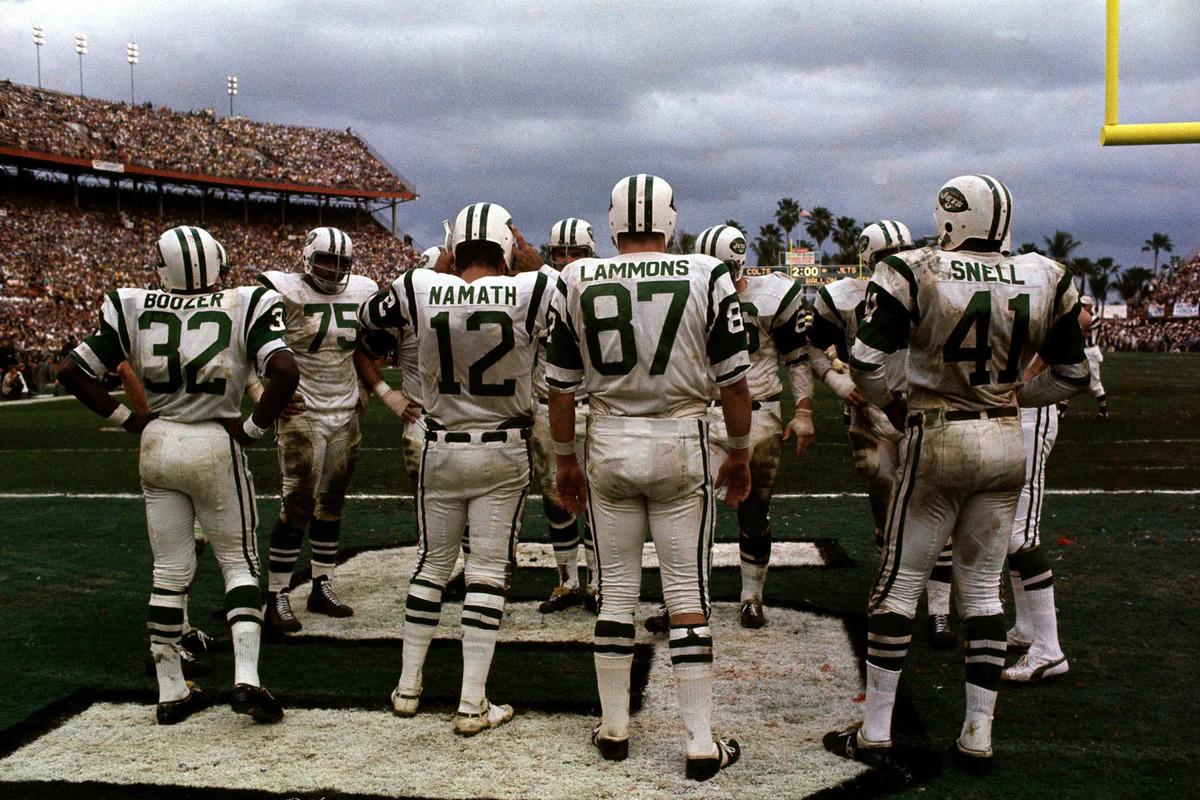
Super Bowl III featured the New York Jets and Baltimore Colts, two organizations with vastly different historical achievements. The Jets, led by the youthful superstar Joe Namath, had been a largely mediocre team up to this point – the ’68 season was only their third winning record historically and first franchise playoff appearance. Upon reaching the postseason, New York closely defeated the reigning AFL Champion Oakland Raiders to advance to the final round.
Baltimore, conversely, was considered an unequivocally unstoppable club. Only losing one game during the season, they posted historic play on both ends of the field and entered the postseason on an eight-game winning streak. Following easy postseason victories against the Minnesota Vikings and Cleveland Browns – the latter of which were shut out after beating Baltimore earlier in the season – they were slated for their first trip to the nation’s fan-favorite duel.
Going into Super Bowl III, as with previous years, the NFL representative – in this case, Baltimore – was significantly favored. The AFL still held a poor reputation in the public’s eye as a talented but disproportionately outmatched league compared to its rival. This belief was only further supported by the uncompetitive nature of the first two Super Bowls, which the NFL’s Green Bay Packers dominated with ease – as a result, New York had little to no believers.
Who did believe, however, was Namath – he made a famous claim three days before the game that “guaranteed” a New York victory with little doubt. He only chose to make that statement due to fan confrontation, and it was expectedly shot down by the media and fans. However, what ensued made Namath’s quote all the more legendary.

Game Data
- Date: January 12, 1969 (’68 NFL / AFL Season)
- Result: New York Jets (NFL) defeat Baltimore Colts (AFL)
- Final Score: 16 – 7
- Location: Orange Bowl, Miami, Florida
- Official MVP: Joe Namath
General Thoughts
This is the first Super Bowl that I had full broadcast access to, as the entire game is on the NFL’s official YouTube account. My viewings of the first two were fan-made audio-highlight synchronized remakes, which were still well-made and informative – however, nothing beats a full watching experience.
The New York Jets’ resilience en route to their Super Bowl win was quite astonishing – they were not a noteworthy defensive team statistically, in fact rating close to average. As a result, seeing them shut down the Colts’ offense so effortlessly was truly mind-boggling. Without context, a viewer would believe the two teams had a major talent disparity in New York’s favor.
What helped the Jets dominate was their abstract range of experience both offensively and defensively, which Baltimore was ill-prepared for. Due to them frequently facing zone defense – something the Colts specialized in amidst a zone-scarce NFL – they were not rattled at all on the offensive end. New York favored short, quick passes that could counter Baltimore’s blitzing – considering this was not Joe Namath’s specialty, his ability to embrace that adjustment was excellent.
Baltimore’s quarterback play was particularly difficult to watch. They were disgustingly poor in response to the Jets’ game-planning and resorted to desperation throws as early as the second quarter. Earl Morrall in particular was a major net negative – while the NFL MVP had an incredible year in a newfound starting role, his inconsistency against hyper-focused opponent coverage showed in the big game. He threw 6-17 on attempts and was intercepted three times before being benched for an injured Johnny Unitas.
New York’s best decision was to take advantage of the Colts psychologically – the latter was quite reactionary to game-shifting plays, including the threat of All-Pro wide receiver Don Maynard. Maynard was injured, and therefore primarily used as a decoy by Namath – however, his slip into a near-game-changing reception in the first quarter completely destroyed Baltimore mentally. Despite Namath’s deep pass to Maynard resulting in an incompletion, the Colts adjusted their defense to hone in on him. This opened up room for other targets, namely Matt Snell, to benefit from incomplete coverage throughout the game and get within range for a single touchdown and multiple successful field goals.
While it was an ugly offensive outing overall, this Super Bowl was ultimately a great tactical battle. The Jets’ defense were the true MVPs of the game – and I would argue the award could have gone to defensive back Randy Beverly, who amassed two interceptions – but Namath certainly had the narrative behind his back, and delivered a stable, successful performance worth appraisal.
Notable Performers
New York Jets 
Joe Namath (QB)
- The New York Jets’ franchise quarterback
- ’68 All-Pro 1st Team
- First career postseason
- Notable Game Stats: 17-28 Cmp.-Att., 206 Yds
Namath’s ’68 campaign lacked the statistical gaudiness of his prior two seasons, but he remained one of the AFL’s most stable quarterbacks in charge of an elite Jets offense. In his first postseason run, he compiled a great aggressive performance to earn a Super Bowl berth.
The star’s play in the big game wasn’t anything too explosive – not even recording a single touchdown – but he was consistent and found his targets reliably to pick apart the Baltimore Colts’ reactionary defense. This was also one of two quarterback performances in the ’68 postseason to not include an interception, alongside Daryle Lamonica’s divisional game against the Kansas City Chiefs.
Randy Beverly (RCB)
- A second-year defensive back upgraded to a full-time starting role
- First career postseason
- Notable Game Stats: 2 Ints., 4 Tackles
Beverly was no standout during the regular season, with few eye-popping statistics and minimal media recognition. However, the 24-year-old came up big against Baltimore, intercepting passes from both Earl Morrall and Johnny Unitas on separate occasions.
Matt Snell (RB)
- The New York Jets’ reputable running back
- 2x All-Pro member and 2x Pro Bowl invitee
- First career postseason
- Notable Game Stats: 4.0 Y/A (10 Att., 121 Yds), 10.0 Y/R (4 Rec., 40 Yds), 1 TD
Snell, while more storied in his first few seasons, remained a properly productive player in the ’68 season with a major impact during Super Bowl III. His Super Bowl-record breaking 121 yards were immense and he was responsible for New York’s only touchdown.
George Sauer (LE-WR)
- The New York Jets’ superstar receiver / end
- 3x All-Pro member and 3x Pro Bowl invitee, including the ’68 season
- First career postseason
- Notable Game Stats: 16.6 Y/R (8 Rec., 133 Yds)
Sauer had been New York’s most consistently successful piece up to this point, with three consecutive All-Pro and Pro Bowl selections by his ’68 campaign. Although his performance was up-and-down – with no touchdowns and a recorded fumble – he still finished the match with a game-high 133 yards and 8 receptions.
Baltimore Colts 
Tom Matte (RB)
- The Baltimore Colts’ star running back
- ’68 Pro Bowl invitee
- ’68 playoffs yards leader
- Notable Game Stats: 10.5 Y/A (11 Att., 116 Yds), 15.0 Y/R (2 Rec., 30 Yds)
Matte had enjoyed a career year, with his first Pro Bowl invitation and a stellar playoffs. The running back was absolutely unstoppable in the NFL Championship Game, with 88 yards on 17 attempts and three touchdowns to decimate the Cleveland Browns in a shutout win.
He remained Baltimore’s go-to target during Super Bowl III, setting a record for yards per rushing carry and finishing second in game rushing yards. However, his performance was spoiled by a momentum-killing fumble to start the second half.
Jerry Hill (RB)
- One of the Colts’ main veteran fullbacks / running backs
- Notable Game Stats: 3.2 Y/A (9 Att., 29 Yds), 1 TD
Hill was not one of Baltimore’s standout players, but was responsible for the only Colts touchdown of the game in the fourth quarter. Unfortunately, the game was well out of Baltimore’s reach.
Greatest Moment
Bowl Grades
- Entertainment Value: C
- The game was certainly slow offensively and lacked flash, but was fueled by a great narrative and was an underrated-ly good tactical showcase from the Jets. Certainly the most fun watch up to this point.
- Team + Matchup Quality: D
- The media expected a blowout, but not in the direction the game went – either way, the matchup was rather boringly lopsided considering both teams were high-quality. What saves this score is the fact that New York put up a fight of completely unprecedented proportions.
- Big Moments: D
- Outside of some big interceptions, this was a slow, hulking game with few highlights. And even the interceptions, while impressive, got old as it progressed – after a while, it was just embarrassing watching Baltimore’s quarterbacks make mistake after mistake.
- Coaching Battle: B
- I was tempted to give this a top score, but the difference in composure between Ewbank and Shula was too jarring. The Jets played an incredible tactical game that I was enamored by, though.
- Historical Significance: A
- It’s impossible to overlook the greatness of this Super Bowl in an all-time context – it was the first instance of an AFL team winning the big game, proving the league could hang with the NFL and later be competitive upon their merger. One of the greatest upsets in American sports history.
Overall Grade: C+
Progressive Super Bowl Ranking
- ’68 – ’69, Super Bowl III: New York Jets v. Baltimore Colts, C+
- ’66 – ’67, Super Bowl I: Green Bay Packers v. Kansas City Chiefs, C+
- ’67 – ’68, Super Bowl II: Green Bay Packers v. Oakland Raiders, F
 Title Runners