

Is the NBA Big Three Era Over?
It’s undeniable that there have been some disappointing big threes in recent NBA history. Three stars that were brought together in the pursuit of creating an unstoppable trio, and instead they disappoint. It’s becoming somewhat of a trend, and teams may start avoiding these team compositions altogether.
But to figure out why these teams are failing, it’s important to understand what exactly a big three is, where they began, the success they’ve enjoyed in the past, and what is happening to them today.
Definition of a Big Three

So, what exactly constitutes a big three? In my eyes, it’s not just three great players that so happen to be on the same team. The team has to make an effort to team up three established stars in the pursuit of making a star trio.
Let me give some examples. The Celtics in the 80s, with their trio of McHale, Bird, and Parish, do not fit as a big three according to my criteria. Yes, they were three incredible players, but Bird and McHale were drafted by the Celtics and when they first teamed up with Parish they were not the established superstars they would become later, but rather rookie prospects. The Celtics weren’t teaming up three stars; they were teaming up one star with two young, promising prospects.
On the other hand, the 90s Bulls trio does count according to my definition. They already had Jordan and Pippen, and both of them were established stars to say the least, and they brought in Rodman as their third star, already aware of the fact that he was one of the best rebounders and defenders in the league. Rodman may be a step down from the others, but he was already a two time All Star and two time DPOY before joining forces with the Bulls.
Overall, simply having three stars doesn’t make you a big three, at least for the sake of this article. We are simply sticking to teams that brought players in for the purpose of teaming up three stars, not those that develop stars on their own terms and make their own big three.
Big Threes Throughout History

There has certainly been a specific “big three era” more recently, and the practice of forming this style of team has been far more popular in recent years, but they’ve been present throughout history. We’ll go through a few of the most prominent, discussing how they were formed, their success, or lack thereof, and whether it was a smart move. There are some I don’t mention, such as the Lakers trio of Kobe, Nash, and Howard.
Chamberlain, West, Baylor (Lakers 1969-1972)
We’ll start with the Lakers big three pictured above, starring Elgin Baylor, Wilt Chamberlain, and Jerry West. The Lakers had already had Elgin and Jerry, but after going to the Finals 5 times since 1962 and not winning a single one, they felt the need to make a change, and that change came in the form of Wilt.
Wilt had been playing in Philly, but the Sixers had been unable to negotiate a new contract with him, so they shipped him to LA in exchange for Jerry Chambers, Archie Clark, and Darrall Imhoff. With that, they teamed up one of the greatest players of all time with two other superstars, hoping to finally steal the Celtics’ glory.
At first, it would be the same level of success as before Chamberlain joined. Despite all three being All Stars in 1969, they would lose in 7 to the Celtics. They would return to the Finals the following year despite Wilt only playing 12 regular season games, but this time would be taken down by Willis Reed and the New York Knicks. They would miss the Finals in 1971, losing to the Bucks in the WCF, this time with Baylor dealing with injury.
Here’s where it gets interesting. Technically, the big three played together in 1972, but Baylor only played 9 games before calling it a career. Without him, West and Chamberlain would go on to beat the Knicks in the Finals, but the whole big three wasn’t present. I would still consider them a successful big three, only really held back by the fact that they were all older versions of themselves.
Jordan, Pippen, Rodman (Bulls 1996-1998)
This may be the most successful big three of all time. Obviously Jordan and Pippen were already established as the faces of the Bulls and the NBA, having won 3 rings from 1991 to 1993, the first three peat since the Celtics during the Russell years. They were doing their thing, and Jordan was the best player in the world.
But then, Jordan retired for two seasons. The Rockets went back to back, and when Jordan came back the landscape of the NBA had shifted a little. So in pursuit of getting back to their old ways, the Bulls brought in defensive and rebounding specialist Dennis Rodman. A character off the court and a beast on it, Rodman elevated the level of the Bulls even more.
The Bulls would win three straight championships, a second three peat, including the best regular season of all time up to that point, finishing with an astonishing 72-10 record in 1996. Although Rodman was obviously slightly below the level of Jordan and Pippen, and especially Jordan, he completed this big three, the most successful of all time.
Olajuwon, Barkley, Drexler (Rockets 1997-1998)
Unfortunately, not every experiment works out. The Rockets had won two championships during the Jordan absence, in ’94 and ’95, both led by Hakeem Olajuwon, with Clyde Drexler supporting in 1995. But then, the Bulls came back in full swing and dominated the league in 1996.
The Rockets weren’t prepared to let their championship window close, however, so they swung for the fences by bringing in Charles Barkley, a former MVP looking to contend one last time, in exchange for Sam Cassell, Robert Horry, Mark Bryant, and Chucky Brown. Barkley was old, as were Clyde and Hakeem, but the Rockets hoped it would be enough to get back to the top and contend one last time.
Unfortunately, the Rockets were old and the competition was tough. All three of the stars for Houston were slightly out of their prime. Hakeem was still an All-NBA caliber player in ’97, and the others were still All Stars that season. They would make a push to the Conference Finals, but lose to the Jazz in 6. The next year they would be just a .500 team, and would get a rematch with the Jazz, this time in the first round. The series would go to 5 (remember, series were best of 5 back then), but they would end up losing, marking the end of the attempted big three in Houston.
This was obviously a less successful team up, and short lived as well. At the end of the day, they were just a little too old, with Barkley and Drexler already in their twilight years.
Pierce, Garnett, Allen (Celtics 2008-2013)
This is when the “big three era” really started. The Celtics had been relying on many Paul Pierce for a few years coming up to 2008, but in a league with insane levels of competition, they needed more. More would come in the pickup of both Ray Allen and Kevin Garnett. Allen would be acquired from the Sonics with a package of Delonte West, Wally Szczerbiak, and the draft rights to the No. 5 overall pick in the 2007 draft which would turn out to be Jeff Green. They also brought in Kevin Garnett from the Wolves for a package of Al Jefferson, Ryan Gomes, Sebastian Telfair, Gerald Green, Theo Ratliff, two first-round draft picks, and cash.
The Celtics had given up a lot to form this trio, but it would pay off immediately. The Celtics would go 66-16 in 2008 after going just 24-58 the year before. They would beat the Hawks, Cavs, and Pistons on their way to the Finals, where they would face Kobe and the Lakers and win in 6. Their first season as a big three and they were champions.
Unfortunately for them, they wouldn’t reach that level for the rest of their time together. They were all already 30+, and the competition in the NBA was extreme at the time, so although they would be a consistent factor in the playoffs, the Celtics big three would never win another finals despite returning in 2010.
James, Wade, Bosh (Heat 2011-2014)
And now, possibly the most iconic big three in NBA history. “The Heatles” were formed when LeBron made the shocking decision to leave his hometown team in Cleveland and make the trip to Miami, joining Dwyane Wade and Chris Bosh. Bosh has been acquired by the Heat in 2010 in a sign and trade deal, and the three playing together made headlines.
The Heatles would make the Finals all four years they played together, winning two. The first year would be the most disappointing. Matched up with an underdog Mavericks team, LeBron would severely underperform, and the Heat would lose in 6 games, a stunning and unexpected loss. They would be back better than ever, however, winning championships in both 2012 and 2013 against the Thunder and Spurs, respectively. They would match up against the Spurs one more time in 2014, but this time resulting in a loss.
LeBron would leave after 2014, and the other members had already started to decline, marking the end of a short but extremely impactful big three tenure, with possibly the most success of any trio in such a short amount of time.
Big Threes Today
So, if most of the big threes we just highlighted in the last segment have been successful, why is there talk about the big three era ending? Because recently, this success has been far less common. Now lets look at the examples of big threes today, and how some of them have fallen short.
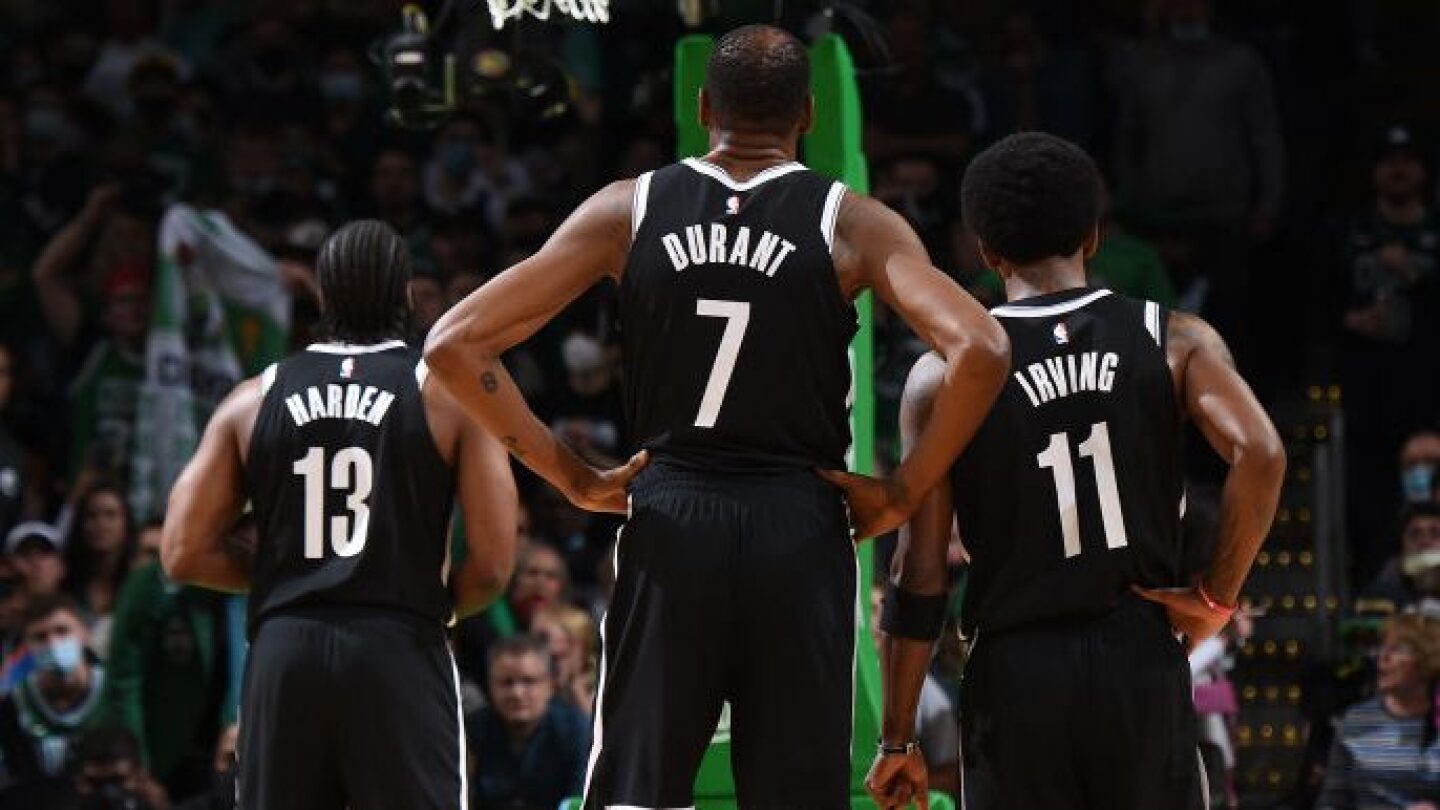
Harden, Irving, Durant (Nets 2021-2022)
Man, this one hurts to write about. As a Nets fan, I was convinced this team was going to the Finals, and it felt like that whenever this trio played together. In this instance, it wasn’t a fit issue. At least, not on the court. Durant and Irving had both signed with Brooklyn before the 2020 season started, although KD would miss that whole season with injury.
Many thought this duo would be enough, but the Nets wanted more. They brought in Harden during the 2021 season, creating one of the most insane big threes ever seen, trading away Caris LeVert, Jarrett Allen, Rodions Kurucs, and a ton of picks. The Nets shot to the top of the power rankings, but that wouldn’t last. The Nets big three only played 16 games together, and in those games they went 13-3, with an unstoppable offense. Unfortunately, this isn’t football. 16 games doesn’t get the job done. Injuries plagued the team, especially in the 2021 playoffs, where both Harden and Irving would miss time, leading to the eventual loss against Milwaukee due to the infamous KD shot where his foot was on the line.
This underwhelming performance would cause Harden to ask out, and he would be shipped away to Philly in exchange for Ben Simmons, Seth Curry, and Andre Drummond. The Nets would lose again in the playoffs that year, and the next year both Irving and Durant would ask out at the deadline.
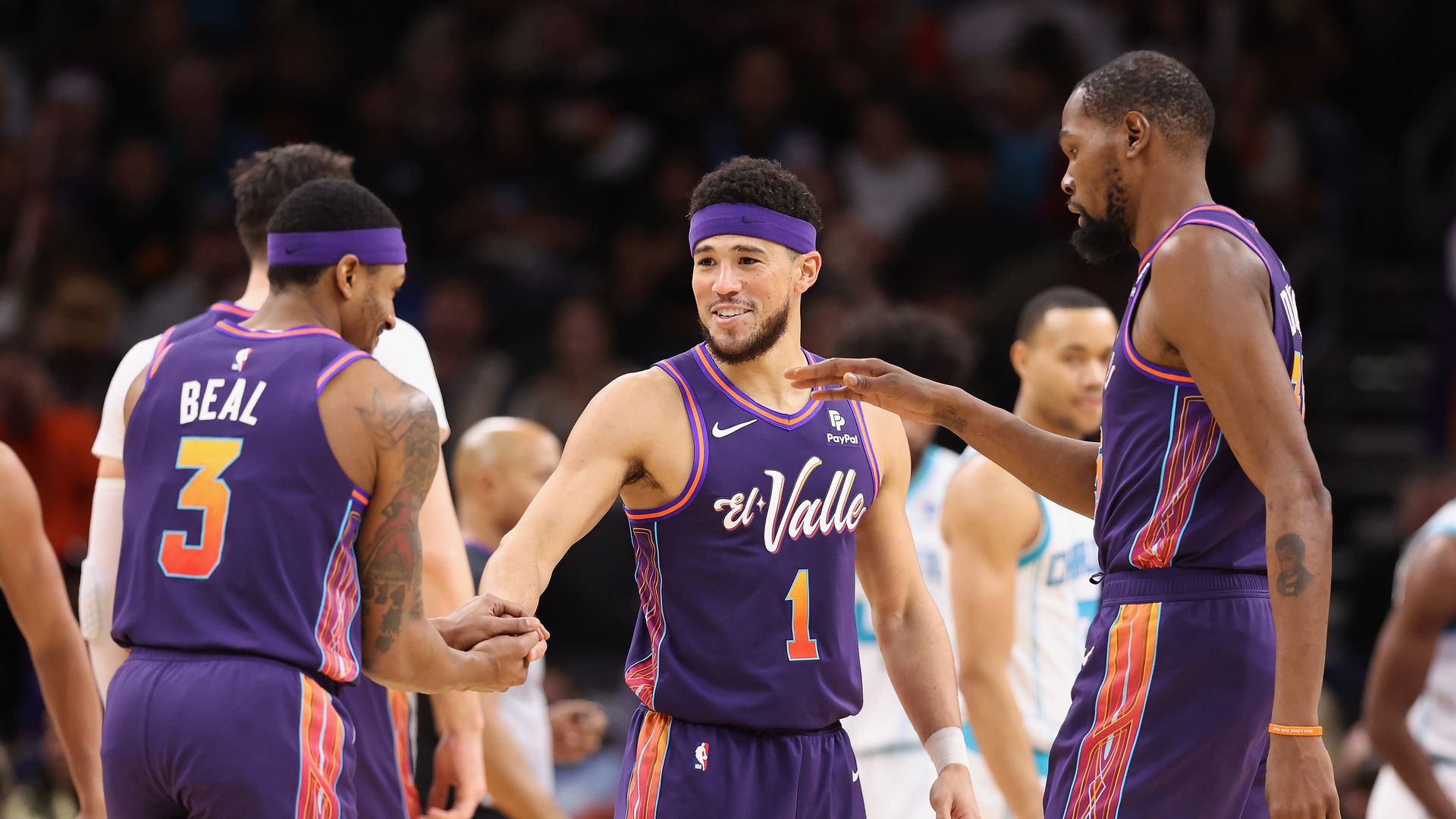
Booker, Beal, Durant (Suns 2024-2025)
Look who it is again. When Durant was shipped to the Suns, he teamed up with Devin Booker, an extremely strong duo, but once again, the Suns wanted more. They brought in Bradley Beal, who had been practically stranded in Washington, without much help at all. This team was expected to perform well, but so far they’ve fallen very short.
Both seasons the Suns big three played together have been extremely underwhelming. They finished sixth in the West in 2024, and when they were matched up against the Wolves it was ugly. The Suns would get swept, despite all the stars being healthy, and would be sent home in embarrassing fashion. This past season, it would be even worse. Even though all three stars played over 50 games, they struggled mightily, missing the playoffs entirely.
But wait, why did this team struggle? They were healthy, and they had three stars. Shouldn’t it work out? The fact of the matter is, the stars were thrown together without much thought of fit. All three are score first players, and although Booker and KD would still perform at a high level, Beal’s production dropped off terribly when playing with other stars, and he ended up being benched for portions of the season. Furthermore, the teams around them were built terribly, without a good defense and without a quality big man. Overall, these three just didn’t fit together.
Embiid, Maxey, George (Sixers 2025-present)
The most recently formed big three, the Sixers have already disappointed practically everyone. After a couple of disappointing playoff exits, the Sixers decided to make a change, signing Paul George for 4 years and 212 million dollars, in order to team him up with former MVP Joel Embiid and young rising star Tyrese Maxey.
This team failed in this past season for a couple of reasons. Firstly, the injuries impacted them severely. Both PG and Embiid have been injury prone throughout their careers, and it was no different this past year. Embiid played just 19 games, and George only 41. In the 19 games that Embiid did play, he looked sluggish and below his normal level, most likely due to the consistent injuries that he has sustained throughout his career. George also underperformed heavily, something not out of character for a 34 year old who has combatted injuries his whole career, but his price tag makes the underperformance sting quite a bit for the 76ers.
Unfortunately, the Sixers made a poor decision teaming up two of the more injury prone players in the league. They knew both Embiid’s and George’s injury history, and George’s age, but still gave George a huge contract and dug themselves into a hole that now may come back to hurt them very badly in the long run.
Are Big Threes a Thing of the Past?
/cdn.vox-cdn.com/uploads/chorus_image/image/73631513/2175042572.0.jpg)
Big threes obviously have their upsides and their downsides in history. Some have worked miraculously, like the Heatles and the Bulls of the late 90s. Then again, many have struggled, like the recently formed ones and the Rockets of the 90s. So should teams keep seeking these out, or should they play it safe and avoid them?
My take is, it depends how much thought goes into the big three. Teams like the Suns seem to have just thrown together their roster without thinking as much about fit, just thinking the talent would take them over the top. The Sixers as well decided to team up two extremely injury prone players, and it hurt hem terribly during the season. If a team does their research and decides that the playstyles do actually compliment each other, that player is worth pursuing.
Secondly, teams can’t throw away their depth and their future just for a chance to team up players. In the NBA today, depth is increasingly important, and blowing up a roster hasn’t helped many teams, especially since injuries are so prominent. Without good backups, if one star goes down, even for a short amount of time, it can seriously hurt a team. If that team gave away all their depth or they paid the star so much that they can’t bring in more solid role players, they hurt themselves more than they help.
Really, the only answer is be smart. In today’s league, a team needs much more than just three stars. I would value one or two stars with a great supporting cast far more, especially if that group is homegrown and their playstyles mesh well. Talent only gets you so far, because every team has talent. It comes down to how well the roster gels, and whether they can work together as one cohesive unit. Big threes aren’t necessarily dead, but the practice of severely overpaying for them is.
 Title Runners