

Retro Redzone: Super Bowl II Flashback
Join me as I chronicle my dive into NFL history! I’ll be watching every Super Bowl and providing my thoughts and analysis.
I’m by no means a complete novice to American Football, but I am working towards developing a deeper, more consistent perspective of it. So light warning – if anything I say sounds amateur or misinformed, it is in no way or form intentionally malicious! I’m still learning a lot.
The Context
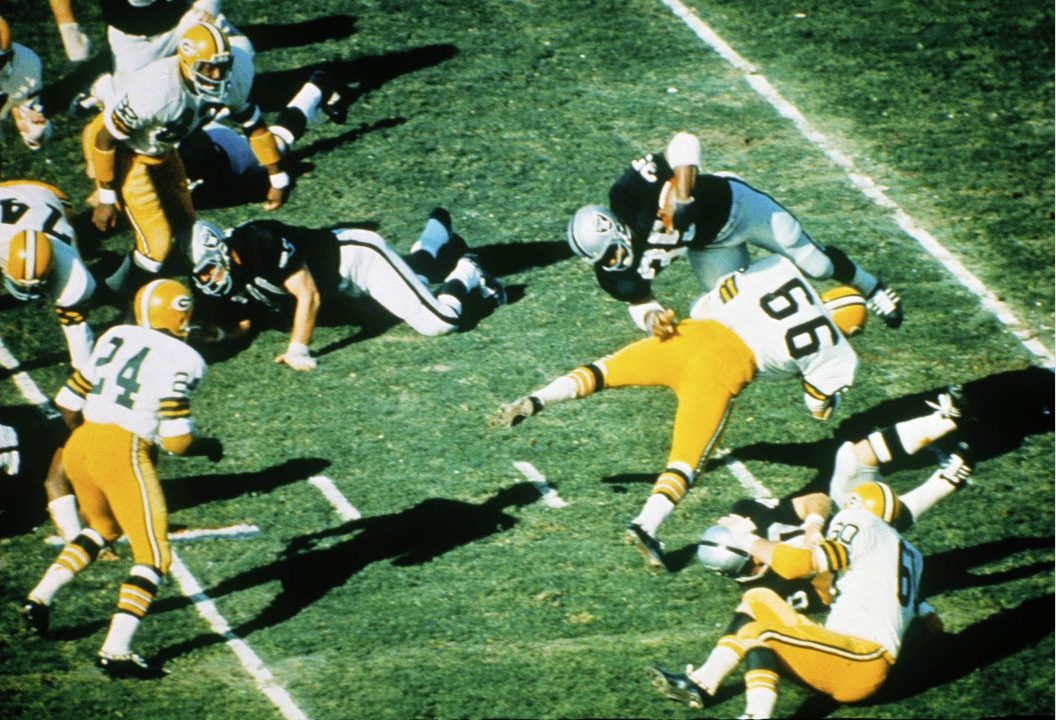
Super Bowl II was an effective extension of the Green Bay Packers dynasty, which had effectively ran football for the entire ’60s decade. The team had won four NFL Championship Games – and the inaugural AFL–NFL World Championship Game – in the span of six years, a level of championship pedigree that had never been seen.
The Oakland Raiders, who were the AFL’s best unit by a significant margin (finishing 13-1; the next-best team was the 9-4 Houston Oilers), comfortably won the AFL Championship Game to compete in the inter-league contest’s second installment. Their dominance was well-understood by pundits, but they were still considered significantly worse than Green Bay. The AFL had yet to assert itself as a legitimate competitive entity among the football landscape, and Oakland looked to reverse that perception.
Miami’s Orange Bowl Stadium was selected as the game’s location, with the consensus agreement being that an annual relocation for the event would be good for its balance and marketability. The venue of choice – which was inhabited by the AFL’s Miami Dolphins – also represented a “fairness” in inter-league representation, as last year’s game was played in the Los Angeles Rams’ Memorial Coliseum.
This game was also rumored to be the last of Packers coach Vince Lombardi – by the event’s end, such speculation was confirmed. This added a level of intensity to the match for Green Bay, who were not only fighting for dominance, but to honor their dynastic leader.

Game Data
- Date: January 14, 1968 (’67 NFL / AFL Season)
- Result: Green Bay Packers (NFL) defeat Oakland Raiders (AFL)
- Final Score: 33 – 14
- Location: Orange Bowl, Miami, Florida
- Official MVP: Bart Starr
General Thoughts
Much like my “watch” of Super Bowl I, I experienced this event through a mix of radio broadcasting and synchronized highlights to simulate the full game, as a complete broadcast does not exist to my knowledge. As a result, it was difficult to capture the significance of every moment, but the big plays were still acknowledged at large.
Not many changes occurred to the game’s rulebook, but they did install the “slingshot” goalposts that are still present to this day. Differences in playstyle, namely less calculated passes and aggressive quarterback coverage, continued to differentiate ’60s football from the modern experience.
This game was significantly less interesting than Super Bowl I, as it carried the similar lopsidedness in competition but without the inaugural atmosphere and iconic moments to balance it out. It’s not hard to understand how Oakland was a great team relative to competition, but their poise and experience was clearly levels below that of Green Bay.
Speaking of experience, researching the iconic Ice Bowl – notorious for its record-breaking extreme temperature of −15 °F – offered some much-needed context to better understand the magnitude of this game. It wasn’t nearly as grueling in nature, but enduring such an extreme matchup meant that Green Bay had to honor Vince Lombardi with a complete championship run. It explains the team’s relentless aggression, despite being faced with what was considered a vastly inferior opponent.
It’s also easy to see how this was the weakest version of their dynastic core. Green Bay had declined overall on both ends of the field, especially defensively, but were still good enough to stifle a Raiders unit that, even among their league, had issues with quarterback protection that were extrapolated in this grand contest.
Finally, it was nice to see Lombardi end his career with Green Bay on a high note, as I’ve grown a fondness for his mythos over the course of studying this NFL era.
Notable Performers
Green Bay Packers 
Bart Starr (QB)
- The Green Bay Packers’ franchise quarterback
- 4x NFL Champion entering Super Bowl II
- Notable Game Stats: 13-24 Cmp.-Att., 202 Yds, 1 TD
Starr’s season was nothing of notable proportions, with statistical lows unseen since taking over as a full-time starter. Still, his efficiency proved useful to Green Bay’s aspirations, proving that statistical gaudiness is not always the key to success.
Don Chandler (K)
- The Green Bay Packers’ star kicker
- ’67 Pro Bowl invitee, the only appearance of his career
- 3x NFL Champion entering Super Bowl II
- Notable Game Stats: 3-3 XPM-XPA, 4-4 FGM-FGA
In his final season, the former extra points leader had a great game with four field goals. Chandler was responsible for both of the first two field goals of the game to put Green Bay up 6-0 and failed to miss a single kick attempt all game.
Boyd Dowler (LE)
- The Green Bay Packers’ star wide receiver and end
- 2x Pro Bowl invitee, including the ’67 season
- 4x NFL Champion entering Super Bowl I
- Notable Game Stats: 35.5 Y/R (2 Rec., 71 Yds), 1 TD
Following an injury that left him unplayable in Super Bowl I, Dowler set out to be properly impactful in his chance for a repeat. He was absurdly productive in his appearance, gaining a bolstering 71 yards in only 2 receptions and scoring the first touchdown of the game – a 62-yard deep completion from teammate Bart Starr. This was the longest reception recorded in any playoff game of the Green Bay Packers dynasty.
Donny Anderson (LHB)
- Green Bay’s young back that had assumed a starting role come playoff time
- Notable Game Stats: 3.4 Y/A (14 Att., 48 Yds), 9.0 Y/R (2 Rec., 18 Yds), 1 TD
The 24-year-old Donny Anderson was still fighting for a starting spot in Green Bay’s offense throughout his sophomore year, but had fully earned the position by the postseason.
He was arguably the game’s most productive target – and was Green Bay’s best, at the very least – with a multitude of successful run attempts and a quick touchdown to extend the Packers’ lead in the third quarter. Anderson finished as the playoffs’ leader in combined receiving and rushing yards.
Ben Wilson (FB)
- A reserve fullback acquired from the Los Angeles Rams
- Notable Game Stats: 3.6 Y/A (17 Att., 62 Yds)
Wilson, who had experienced a rocky tenure with the Los Angeles Rams, went the entire ’66 season without playing and joined Green Bay in the off-season. The USC star’s role was inconsistent throughout the season, but he emerged as the Packers’ primary target in Super Bowl II with a game-high 17 rushing attempts and 62 rushing yards.
He did not record a touchdown, but his productivity was still key to upholding the Packers’ offense. This was also attained over what was largely three quarters of play, as he missed the majority of the fourth quarter looking for his missing contact lens.
Oakland Raiders 
Daryle Lamonica (QB)
- Oakland Raiders’ franchise quarterback
- ’67 All-Pro 1st Team
- Notable Game Stats: 15-34 Cmp.-Att., 208 Yds, 2 TDs
Lamonica, while not nearly as historically gilded as Bart Starr, arguably outplayed the reigning Super Bowl MVP despite the loss. He was certainly the more aggressive and dynamic offensive player, although that came at the cost of passing efficiency and ball protection.
Still, the quarterback, alongside top target Bill Miller, was Oakland’s only reliable source of offense. Green Bay’s defensive pressure was just too stifling for Lamonica to find comfortable openings – his assertive playstyle was appreciated by his club, but could not translate to victory.
Bill Miller (LE)
- One of the Oakland Raiders’ top receivers and ends
- Notable Game Stats: 16.8 Y/R (5 Rec., 84 Yds), 2 TDs
Miller’s regular season was not one to remember, although it was his first year as a starter since his All-Pro season with the Buffalo Bills in 1963. He did emerge as the game’s top receiver, however, with a game-high 5 receptions and 84 receiving yards. He was responsible for the only two Oakland touchdowns of the game, although the latter came while they were down 33-7 and had little impact on the final outcome.
Greatest Moment
Bowl Grades
- Entertainment Value: F
- It was pretty hard to maintain interest in this game. The lack of competitiveness was grueling and although it isn’t the event’s fault, the means by which I had to view it was hard to keep up with.
- Team + Matchup Quality: F
- It was a very unimpressive matchup – Oakland ran the AFL, but put up absolutely no fight in this contest. This was also one of the less entertaining Packers teams, with almost no true stars anymore and a less watchable offense.
- Big Moments: D
- The Boyd Dowler deep completion saves this grade from being abysmal. That play was certainly the most explosive of either Super Bowl thus far.
- Coaching Battle: D
- Lombardi’s presence in the Ice Bowl felt stronger than this game, but he still remained a unique force with one of the greatest minds in football history. He certainly willed a post-prime Packers team to one final stand, and John Rauch had no answers for that on either end.
- Historical Significance: D
- Being the final Super Bowl of the Packers dynasty – and Lombardi’s final game – gives Super Bowl II some light importance, although it lacks relevance outside of that organization’s triumph.
Overall Grade: F
Progressive Super Bowl Ranking
- ’66 – ’67, Super Bowl I: Green Bay Packers v. Kansas City Chiefs, C+
- ’67 – ’68, Super Bowl II: Green Bay Packers v. Oakland Raiders, F
 Title Runners