

Retro Redzone: Super Bowl I Flashback
Join me as I chronicle my dive into NFL history! I’ll be watching every Super Bowl and providing my thoughts and analysis.
I’m by no means a complete novice to American Football, but I am working towards developing a deeper, more consistent perspective of it. So light warning – if anything I say sounds amateur or misinformed, it is in no way or form intentionally malicious! I’m still learning a lot.
The Context
So! Super Bowl I. The unspoken beginning to the “modern” National Football League (NFL) as we know it, and the first of many culturally significant ceremonious outings. But watching this game, you would have never expected it to have that kind of impact.
Then-called the AFL–NFL World Championship Game, this inaugural iteration bears little to no resemblance to the star-studded spectacle of the present-day. Instead, it functioned as an advertisement for the incoming merger between the NFL and American Football League (AFL), holding competitive undertones with the implication of league superiority on the line.
The Green Bay Packers and Kansas City Chiefs, who won the NFL and AFL Championships respectively, were designated for representation in a one-and-done match that would decide which league boasted the best team. The Super Bowl was not yet seen as the sport’s all-encompassing championship game, given the two leagues had yet to merge – instead, Super Bowl I, alongside the next three iterations, were considered standalone inter-league contests that have retroactively been pinned as official titles.
Game Data
- Date: January 15, 1967 (’66 NFL / AFL Season)
- Result: Green Bay Packers (NFL) defeat Kansas City Chiefs (AFL)
- Final Score: 35 – 10
- Location: Los Angeles Memorial Coliseum, Los Angeles, California
- Official MVP: Bart Starr
General Thoughts
As a sports history buff, getting to familiarize myself with the beginning to such a pivotal event was joyful. It’s almost like starting a journey, in a sense – I’m grateful to have so many viewing experiences of later Super Bowls ahead of me, but for now, I’m more than content enjoying the experience of this one.
Old-school football certainly has plenty of interesting differences in playstyle, rules, and culture, as with all older sports forms. Some things I noticed from the film:
- The passing game was a lot less calculated. Deep passes were more common, causing a higher interception percentage and closer pass-to-rush attempt ratio.
- Quarterbacks had little to no protection. They stayed in the pocket less because of the inevitable physicality they were met with – the hits defenders committed were far more violent.
- The kicking in this game was solid, but kicking quality in general was far worse in this era. This is due to less developed techniques, which overpowered the advantage of closer-proximity goalposts for kicking optimization.
The erratic nature of passing and less thorough defensive coverages left offenses dependent on rushing to achieve touchdowns. For example, this ’66 season featured a 2.6:2 ratio of passing to rushing touchdowns, as opposed to the 3.3:2 ratio of the ’24 season.
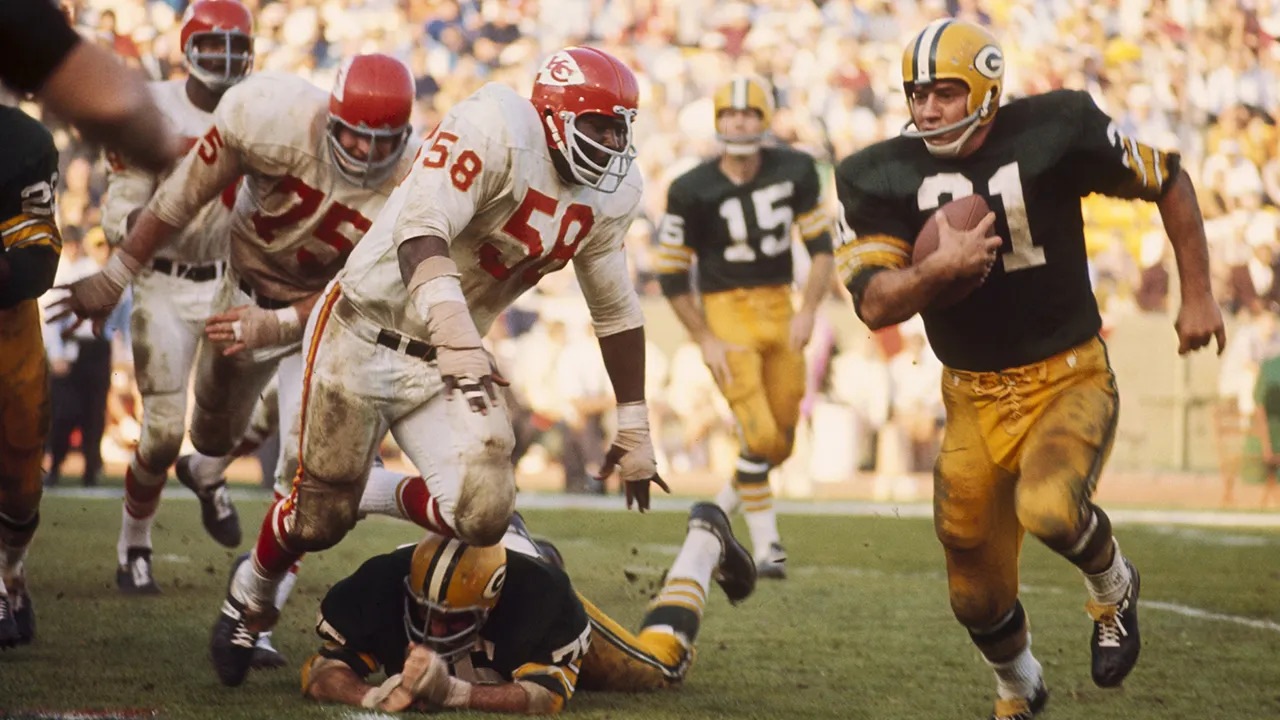
The prevalence of man defense, which was overwhelmingly favored in an era where zone defense had not yet established itself, enabled rugged running backs to dominate their assignments one-on-one. Such is on great display here, where Jim Taylor slices through a poorly-executed Kansas City defense to score Green Bay’s second touchdown of the game:
That’s not to imply that offenses solely succeeded because of easy opportunities, though – the quarterback play and talent of multiple skill position pieces was certainly impressive, perhaps more than a lot of fans are willing to admit about the era.
…And since we’re already on the topic, why not talk about them a little more?
Notable Performers
Green Bay Packers 
Bart Starr (QB)
- The Green Bay Packers’ franchise quarterback
- ’66 All-Pro 1st Team and MVP (the only instance of both in his career)
- 3x NFL Champion entering Super Bowl I
- Notable Game Stats: 16-23 Cmp.-Att., 250 Yds, 2 TDs
Starr was the perfect fit for a Packers roster full of weapons, capable of rising to the occasion in playoff settings with no fear. Green Bay’s offensive process felt very secure under Starr’s lead – he was absurdly efficient at finding targets (with a 16-23 completion rate) and ran with poise during the game despite Kansas City’s early aggression.
It’s certainly important to acknowledge that Starr benefited from a deep supporting cast that softened his job difficulty, but his playoff rising was historically valuable. It’s also worth considering that in the mid-’60s, where Green Bay’s offense and especially running game had declined, Starr posted his best seasons and translated them to the postseason.
Max McGee (E)
- A post-prime end that had no postseason expectations, but made NFL history
- 1x Pro Bowl invitee, five years removed from last appearance
- Notable Game Stats: 19.7 Y/R (7 Rec., 138 Yds), 2 TDs
McGee’s Super Bowl I story is one for the books – after spending his night out and entering the game hungover and fatigued, the former star entered the game for injured starter Boyd Dowler. Forced to borrow a helmet due to poor preparation, McGee entered the field on fire and recorded the first touchdown in Super Bowl history.
The end also managed a second touchdown in the third quarter to put Green Bay up 17 points, silently ending Kansas City’s title hopes. McGee’s 2 touchdowns and 138 recorded yards both exceeded the entirety of his regular season production that year.
Jim Taylor (FB)
- The Green Bay Packers’ long-tenured fullback
- 5x Pro Bowl invitee, two years removed from last appearance
- 3x NFL Champion entering Super Bowl I
- Notable Game Stats: 3.3 Y/A (17 Att., 56 Yds), 1 TD
Taylor was no longer within his prime at the time of Super Bowl I, recording several of his worst personal statistics of the ’60s decade. However, the Hall of Fame lock proved to still be borderline non-scheme-able within the confines of a playoff situation, piecing apart Kansas City’s defenders with a tenacity so aggressive it shattered their confidence.
The fullback’s second-quarter touchdown didn’t quite put the game out of reach for the Chiefs, but did demoralize the AFL Champions heading into the second half. It exposed their inability to defend the run, something our next name of interest certainly exploited…
Elijah Pitts (HB)
- A reserve-turned-starter with an increased workload during Super Bowl 1
- Notable Game Stats: 4.1 Y/A (11 Att., 45 Yds), 2 TDs, 32 Rec. Yds
A perennial backup to the illustrious Paul Hornung during his early career, Pitts was upgraded to a semi-regular starting position by the ’66 season. This translated to the big-time game, where he functioned as Green Bay’s most productive runner and destroyed any hopes for a Chiefs comeback in the second half.
Pitts was a tough cover for the Chiefs goal-line defense, with the halfback only recording six yards between both of his touchdown possessions. Kansas City was very susceptible to overplaying the opposing quarterback in short coverage, which left Pitts open for an easy route on both goals – it is not only a testament to teammate Bart Starr’s threat of play-calling, but Pitts’ own quick instincts as well.
Willie Wood (SS)
- The Green Bay Packers’ superstar safety
- ’66 All-Pro 1st Team
- 3x NFL Champion, 4x All-Pro invitee, and 4x Pro Bowl invitee entering Super Bowl I
- Notable Game Stats: 1 Int., 50 Yds
Despite going undrafted as a college quarterback, Wood was a quick riser upon shifting to a defensive role. He led the NFL in interceptions by his third year and earned a reputation as one of the league’s perennial defensive menaces. While his overall postseason production seemed quiet, he was responsible for a momentum-shifting interception in Super Bowl I that rendered Green Bay victorious.
Aggression towards the Chiefs pocket by Green Bay’s linebackers forced an awry pass from their quarterback Len Dawson, which Wood swiftly intercepted and held for a hefty fifty yards. This is largely considered to be the turning point of the game that crudely shifted things in the Packers’ favor, and such suspicions were validated by an Elijah Pitts touchdown a play later.
Kansas City Chiefs 
Len Dawson (QB)
- Kansas City Chiefs‘ franchise quarterback
- ’66 All-Pro 1st Team
- 1x AFL Champion and 1x MVP entering Super Bowl I
- Notable Game Stats: 16-27 Cmp.-Att., 211 Yds, 1 TD, 8.0 Y/A (3 Att., 24 Yds)
Dawson was an AFL sensation, serving as the league’s overall best quarterback of the ’60s decade. His Chiefs enjoyed a lightning-in-the-bottle championship in ’62 as the Dallas Texans, and found a new fire in ’66 behind the star’s career-best year.
While Kansas City’s final result in Super Bowl I was of underwhelming quality, Dawson played well given the circumstances. He provided his trademark high-caliber completion rate while accounting for 88% of the team’s total yards – the offense was simply too pass-dependent to succeed against a well-oiled Packers defense.
There is a serious argument to be made that he was the better performing quarterback of the game, especially in terms of utilization and talent – Dawson’s arm and running game both stood out as strong physical abilities that gave Kansas City offensive variety, but it did not translate to victory. The Chiefs, despite having the better top-end talent relative to league, struggled to overcome the experience and sharpness of Green Bay – and that may be a testament to the NFL’s then-indisputable superiority.
Curtis McClinton (FB)
- Kansas City Chiefs‘ star halfback
- 2x Pro Bowl invitee, including the ’66 season
- 1x AFL Champion and 1x All-Pro 2nd Team entering Super Bowl I
- Notable Game Stats: 17.0 Y/R (2 Rec., 34 Yds), 1 TD
The Chiefs’ former All-Pro member was still a star in ’66, finishing top ten in rushing touchdowns. McClinton’s presence on the run wasn’t as a prominent as usual, but he still accounted for their only touchdown off a pass from Len Dawson.
Willie Mitchell (RCB)
- Third-year defensive back
- Notable Game Stats: 1 Int., 7 Tackles
Mitchell was arguably the game’s most present defensive force – he was one of two players to record an interception and was far and away Kansas City’s most active tackling force. Unfortunately, their overall defensive structure was too disorganized to limit Green Bay collectively.
Greatest Moment
Bowl Grades
- Entertainment Value: D
- Not the most entertaining game, outside of being in awe of its importance historically. The game never felt truly close, even after Kansas City’s second-quarter push – the Packers were just too good.
- Team + Matchup Quality: C
- While both teams were respectively dominant in their leagues, the Packers did exemplify why there was such a bias towards the NFL at the time. They were just more thoroughly talented and prepared. The Chiefs never felt like a sustainable opponent, either – their 11-2-1 season was an anomaly at the time, as their only other standout season was four years prior in ’62.
- Big Moments: D
- Outside of the Willie Wood interception, there weren’t many jaw-dropping plays. It was a very fundamental game and thorough beating by Green Bay.
- Coaching Battle: C
- Vince Lombardi’s execution on defense was incredible, and it’s easy to see why the Packers thrived as they did. However, Hank Stram’s play-calling on both ends was reeking of unsustainability and he did a poor job preparing his defense for Green Bay’s constant goal-line pressure. Not a very even sideline duel.
- Historical Significance: A
- This was always going to be the absolute best grade, no matter what – it’s the first Super Bowl, after all! It was great to see where the tradition started, even if it was considered a different type of game at the time. It’s not the most groundbreaking football to watch but I still recommend listening to the broadcast and seeing the handful of clips if you ever can, it’s worth the historical context.
Overall Grade: C+
Progressive Super Bowl Ranking
- ’66 – ’67, Super Bowl I: Green Bay Packers v. Kansas City Chiefs, C+
 Title Runners